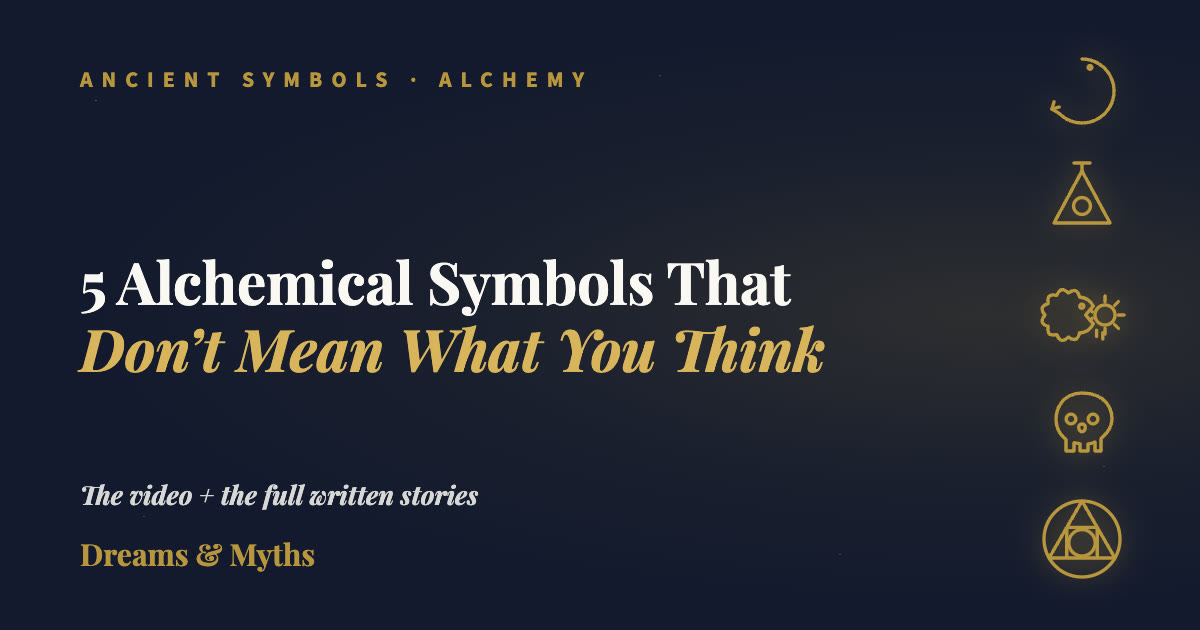
Alchemy's symbols were guarded like treasure for centuries — not because they were recipes for gold, but because each one hides an instruction for being human. We made a full video walking through the five great ones; the article below is the map, with links to a deep dive on each symbol.
1. The Ouroboros — Nothing Is Lost
The snake eating its own tail first appears on a gilded shrine in Tutankhamun's tomb, guarding a god through the night. Seventeen centuries ago, the alchemist Cleopatra drew it half dark and half light around three Greek words: hen to pan — "one is the all." Whatever the work consumes, feeds the work. Your ending is material for your next beginning. Read the full story →
2. VITRIOL — Go In, Not Out
The name of the workshop's most corrosive acid is also a seven-letter Latin acronym: Visita Interiora Terrae Rectificando Invenies Occultum Lapidem — "visit the interior of the earth; by rectifying, you will find the hidden stone." Descend into yourself; correct what you find; the thing you seek is buried where you least want to dig. Read the full story →
3. The Green Lion — Dissolution Begins the Work
Alchemy's strangest image — a green lion devouring the sun, printed in the Rosary of the Philosophers in 1550 — is a lab note (acid swallowing gold) and a law of transformation: before anything can be remade, the finished thing must be unmade. The lion is not evil. It is early. Read the full story →
4. Caput Mortuum — Check the Flask
The "dead head" was the burned residue at the bottom of the flask, marked with a skull and treated as worthless. But the ash held the fixed salt; the blackening came first in the work, not last; and one famous dead head — colcothar — became both a painter's pigment and the rouge that polishes gold. What burned away was not all of you. Read the full story →
5. The Squared Circle — The Impossible Task, Done Anyway
A circle in a square in a triangle in a circle: a geometric construction proved impossible in 1882, adopted knowingly as the emblem of the philosopher's stone. Michael Maier's 1618 recipe — man and woman to circle, to square, to triangle, to circle again — was never about a rock. The stone is a finished self. Read the full story →
One Message, Five Locks
Five symbols, one message, kept in code for four hundred years: the gold was never the point — the work is done on you. Every claim in the video and in these articles is sourced, from Tutankhamun's shrines to the 1550 Rosarium to Lindemann's 1882 proof; each linked article closes with its references.
Frequently Asked Questions
What are the most common alchemical symbols?
The workshop shorthand was built from the seven planetary metals and the three principles. Gold is the sun (a circle with a dot), silver is the crescent moon, mercury is the planet Mercury's glyph, and iron, copper, tin and lead borrow the signs of Mars, Venus, Jupiter and Saturn. The three principles are sulfur (a triangle over a cross), mercury (the same planetary glyph), and salt (a circle cut by a horizontal line). The four elements are triangles: fire points up, water points down, air is fire with a bar, earth is water with a bar.
Does the ouroboros mean infinity?
Not originally. The tail-eating serpent stood for cyclical renewal and the unity of the work, summed up in Cleopatra the Alchemist's caption hen to pan, "one is the all." The lemniscate (∞) is a separate, much later mathematical sign introduced by John Wallis in 1655; the two ideas were only linked by modern readers.
What does VITRIOL stand for in alchemy?
Visita Interiora Terrae Rectificando Invenies Occultum Lapidem: "visit the interior of the earth; by rectifying you will find the hidden stone." The acronym appears in Basil Valentine's writings and on the Rosicrucian-era engravings, and it doubles as the name of the sulfate acids the laboratories actually used.
Where can I read the deep dives?
Each symbol above has its own sourced article: the ouroboros, VITRIOL, the green lion, caput mortuum, and the squared circle. For the wider tradition start with what a myth actually is and Carl Jung on symbols.