The Dead Head
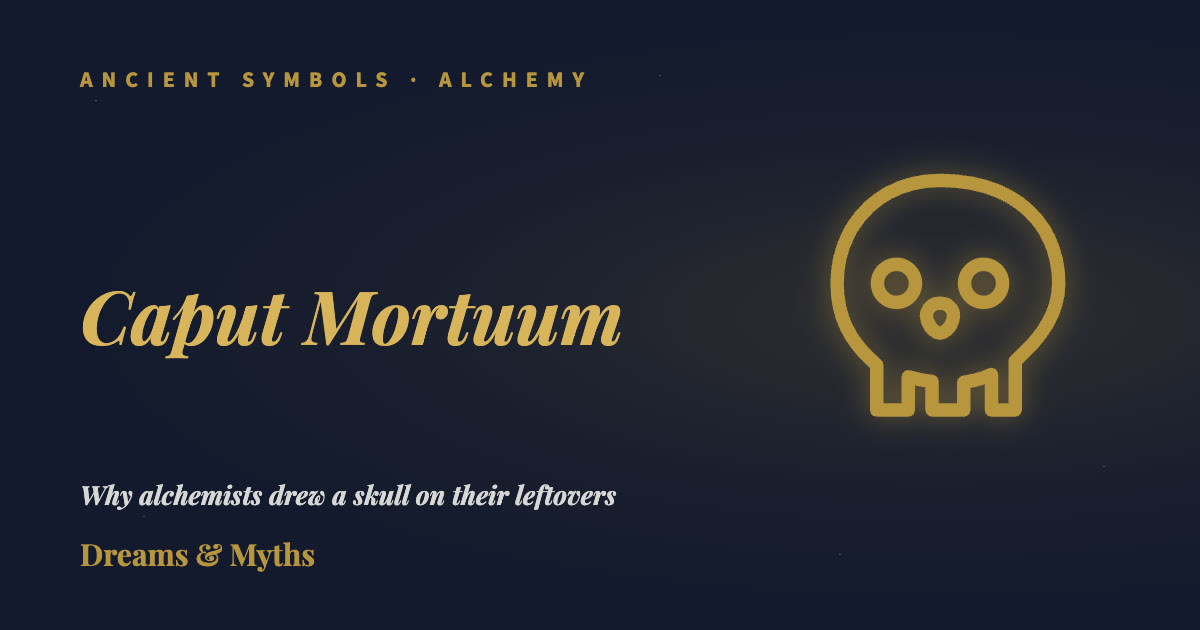
When the fire died and the vapors had been collected, something was always left in the bottom of the flask: a caked, burned, apparently worthless remainder. Alchemists gave it a name with a shrug built in — caput mortuum, Latin for "dead head" — and in their notebooks they marked it with a stylized skull.
It meant: everything valuable has been driven out of this. What remains is ash. In time the phrase escaped the workshop and became shorthand for anything drained of its worth — a "caput mortuum" was a spent thing, an empty husk.
The Careful Ones Kept It
Most workshops threw the dead head out. The careful ones did not — because in the tradition's own theory of matter, the ash still held the fixed salt of the substance: the stable, incombustible principle that survived the fire. That salt was recovered from the ashes and returned to the work. The residue was not the opposite of the goal; it was one of the goal's ingredients, wearing a disguise.
Ash Comes First, Not Last
There is a second reversal hiding in the symbol. In the classical sequence of the great work, the blackening — nigredo — comes first, not last. The matter must die, char, and blacken before it can be washed, whitened, and perfected. So ash at the bottom of the flask was not merely failure: it was evidence that the process had actually begun. The skull marks a stage, not a verdict.
A Skull in the Notation
The dead head even earned a place in the tradition's shorthand. Alongside the planetary signs for the metals and the triangles of the elements, alchemical and early chemical manuscripts used a small skull-like sigil to mark residue — caput mortuum as a working symbol, jotted in a margin the way a modern chemist writes "ppt." for precipitate. It is a striking habit when you notice it: a memento mori built into lab notation, a little death recorded at the bottom of every distillation.
The Dead Head's Second Life
Then the leftovers got famous. Chemists had a name for one dead head in particular: colcothar, the red-violet iron oxide residue left when green vitriol was roasted for its acid — literally the caput mortuum vitrioli, the dead head of vitriol. Ground fine, it turned out to be two things at once:
First, a pigment. Painters knew the violet-brown iron oxide as caput mortuum — a muted, dignified purple with the warmth of dried blood and none of its drama — and used it for centuries, notably for the robes of saints, patriarchs, and donors in religious painting. It earned that role honestly: iron oxides are among the most lightfast pigments there are, so the color of the residue outlasts brighter paints around it. You can still buy caput mortuum from serious pigment houses today, name intact. The residue of the fire ended up clothing the holy — permanently.
Second, a polish. As jeweler's rouge, that same fine red powder became the standard finishing compound for precious metal — the thing you use to bring gold to its highest shine. Sit with that for a moment: the waste product of one work became the finishing touch of another.
Not to Be Confused With Mummy Brown
One caution for pigment hunters: caput mortuum the iron-oxide color is sometimes confused with mummy brown, the grisly 16th–19th century pigment actually ground from embalmed remains. They are different substances with different histories — caput mortuum only sounds like it came from a corpse. The name is pure alchemy: dead head, the residue of the fire, iron all the way down. The confusion is understandable, and the distinction is exactly the kind of thing the alchemists would have enjoyed: even the pigment's name asks you to check what is actually in the flask before you judge it.
Check the Flask
That is what the skull actually marks: not death, but leftover material the fire could not take. After any burn — a project, a season, a self — the alchemists would tell you the same thing. What burned away was not all of you. Check the flask.
Part of our alchemical symbols series — see the full video roundup and the code hidden in the acid itself in VITRIOL: The Hidden Code. Sources include Abraham's A Dictionary of Alchemical Imagery, Principe and Newman on salt-of-ash operations, and the pigment literature (Eastaugh et al., Pigment Compendium).