The Tidiest Symbol in Alchemy
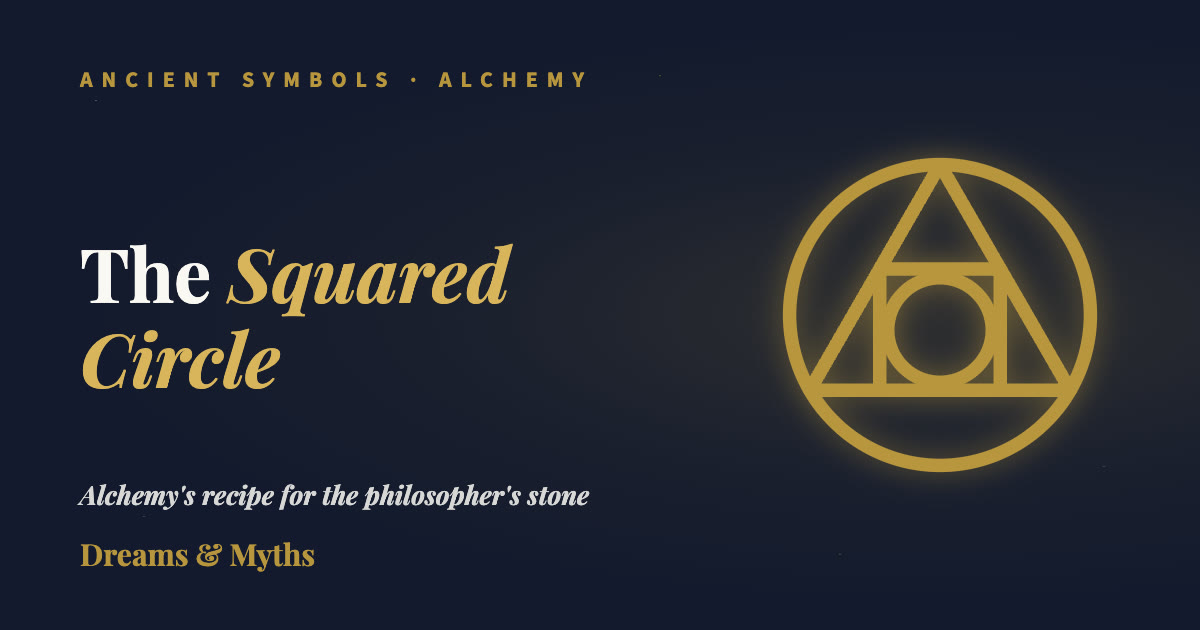
A small circle, inside a square, inside a triangle, inside a great circle. No serpents, no lions, no blood from the sky — just four nested shapes. This is the squared circle, and it is alchemy's neatest symbol for its most impossible object: the philosopher's stone.
An Impossible Problem, Chosen on Purpose
"Squaring the circle" was already ancient when the alchemists borrowed it: construct, with compass and straightedge alone, a square with exactly the area of a given circle. Geometers chased it for over two thousand years. In 1882, Ferdinand von Lindemann proved that π is transcendental — and with that, the construction was proved impossible, permanently.
The alchemists had adopted the figure as an emblem centuries before the proof, and they seem to have understood the spirit of it perfectly: they chose a task that cannot be completed by ordinary means as the sign of their highest work. If the stone were easy, it would not be the stone.
Two Thousand Years of Trying
The problem's pedigree gave the emblem its weight. Plutarch records that Anaxagoras worked on squaring the circle while imprisoned in Athens in the fifth century BC — making it perhaps the oldest documented "prison mathematics" in history. By the early modern period, "circle-squarer" had become a byword for a certain kind of obsessive, and academies grew so tired of submitted "solutions" that some formally refused to review them. The alchemists watched all of this and still chose the figure as their emblem — not despite the futility, but because of what the futility filtered for: only someone transformed by the attempt would keep attempting it.
Maier's Recipe
The classic statement is Emblem XXI of Michael Maier's Atalanta Fugiens (1617/18), where a philosopher measures the figure with compasses while the epigram gives the recipe:
"Make of a man and woman a circle; then a quadrangle; out of this a triangle; make again a circle, and you will have the Stone of the Philosophers."
Maier built the strangest delivery system in publishing history for that idea: each of his fifty emblems came with an engraving, an epigram, a discourse — and a fugue for three voices, actual sheet music, meant to be sung while you studied the image. A seventeenth-century multimedia book, engineered so the idea would enter by eye and ear at once.
The Philosopher With the Compasses
The engraving itself is worth describing. A robed philosopher leans over a wall with a great pair of compasses, drawing a circle. Inside his construction stand a man and a woman — the two principles the work must unite — enclosed by the triangle and the square, the whole figure bounded by the circle he is completing. The recipe is not narrated; it is performed: you watch geometry being done to human beings. Alchemy's most abstract emblem is also one of its most intimate — the stone is made out of people.
Reading the Shapes
The traditional key: the square is the four elements — earth, water, air, fire; the material world in all its division. The triangle is body, soul, and spirit. And the circle that begins and completes the figure is unity — the One from which the work departs and to which it returns. The recipe reads: take what is divided, resolve it through body, soul, and spirit, and return it to unity.
Which is to say: the stone was never a rock. It was a finished self.
That reading also dissolves the tradition's favorite paradox. The texts insist, over and over, that the stone's raw material is found everywhere, costs nothing, and is trodden underfoot and despised by fools — riddling language that sent generations of literalists digging through dunghills. But if the work's true matter is the worker, the riddle answers itself. The raw material of a finished self really is lying around everywhere, unregarded: it is the unfinished one you already have. No substance in the shop is cheaper, and nothing is harder to perfect.
Ending on a Circle
There is a quiet rhyme here with the oldest symbol in the tradition. Alchemy's first great emblem is a serpent bent into a circle — the Ouroboros — and its last is a circle drawn closed around everything a person is. The tradition opens and closes with the same shape: the line that comes back to its own beginning.
Part of our alchemical symbols series — watch the full video at 5 Alchemical Symbols That Don't Mean What You Think. Sources: Maier's Atalanta Fugiens (Emblem XXI), H.M.E. de Jong's study of the work, Lindemann's 1882 proof, and Abraham's A Dictionary of Alchemical Imagery.