The Jackal at the Threshold
In the dimly lit chambers of ancient Egyptian tombs, one figure appears more consistently than any other: a tall, dark figure with the head of a jackal and the body of a man, standing watch over the dead with an air of solemn authority. This is Anubis — known to the ancient Egyptians as Anpu or Inpu — the god who guides the dead through the underworld, presides over the embalming process, and weighs the hearts of the deceased to determine their eternal fate.
Anubis is one of the oldest deities in the Egyptian pantheon, with evidence of his worship dating back to the First Dynasty (c. 3100 BCE) and possibly earlier. For most of Egyptian history, he was the god of the dead — the primary deity associated with death, burial, and the afterlife. Only later, during the Middle Kingdom (c. 2055-1650 BCE), was he partially displaced by Osiris, who assumed the role of ruler of the underworld while Anubis retained his functions as guide, embalmer, and judge.
The Jackal-Headed God
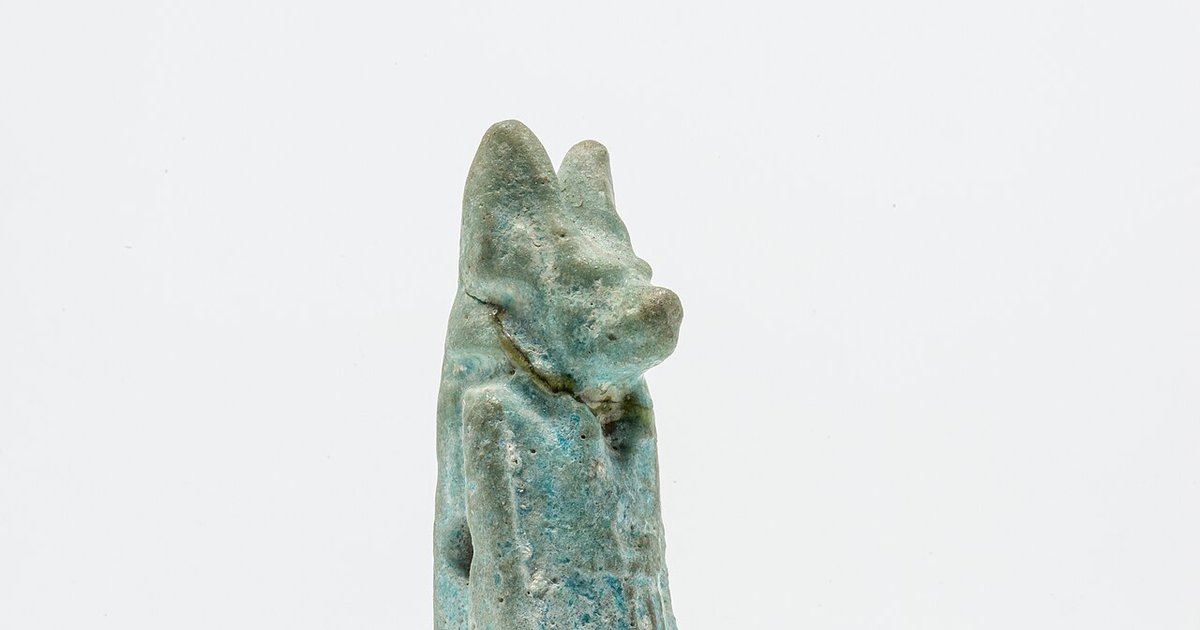
Anubis is depicted as either a full jackal (or jackal-like canid) lying on a chest or pedestal, or as a man with a jackal's head, typically with black skin. The choice of the jackal was not arbitrary — it was a response to observable reality.
In ancient Egypt, jackals and wild dogs were commonly seen prowling the edges of the desert where the dead were buried. They dug at shallow graves and scavenged corpses. Rather than viewing these animals as desecrators, the Egyptians performed a characteristic act of theological judo: they transformed the threat into a protector. By making the jackal the guardian of the dead, they symbolically converted the very creature that threatened the dead into their divine defender.
Anubis's black coloring is not the natural color of a jackal. It carries symbolic meaning:
- Black Nile soil — The rich, dark silt deposited by the Nile's annual flood was associated with fertility and regeneration. Black represented life emerging from death.
- Decay and transformation — The darkening of a body during mummification connected Anubis to the transformative process that prepared the dead for the afterlife.
- The night sky — The darkness through which the dead must travel to reach the afterlife.
The black jackal, then, is not a symbol of death as annihilation. It is a symbol of death as transformation — the dark passage through which one must travel to reach new life.
Anubis's Origins and Family
Anubis's parentage varies across Egyptian sources, reflecting his ancient origins and the evolving nature of Egyptian theology over three millennia.
In the oldest traditions, Anubis was the son of Ra (the sun god) or of the cow goddess Hesat. He was among the first gods, predating the Osiris mythology that would later come to dominate Egyptian religion.
In the later Osirian mythology, Anubis was the son of Osiris and Nephthys. According to this version, Nephthys (who was married to the chaos god Set) disguised herself as her sister Isis to seduce Osiris. When the child Anubis was born, Nephthys abandoned him in the wilderness out of fear of Set's wrath. Isis found the infant and raised him as her own, and Anubis became a loyal ally of both Isis and Osiris.
This later genealogy served a specific theological purpose: it subordinated Anubis to Osiris within the divine hierarchy while explaining why Anubis willingly served Osiris as guardian and embalmer of the dead. But the archaeological evidence suggests that Anubis was originally independent of and predating the Osiris cycle — a primordial death god who was later incorporated into the more elaborate Osirian narrative.
The First Embalmer
Anubis's most important mythological role is as the inventor and patron of mummification. According to the Osiris myth, when Osiris was murdered by his brother Set — his body dismembered and scattered across Egypt — it was Anubis who gathered the pieces, reassembled the body, and performed the first embalming.
Working with Isis and the god Thoth, Anubis wrapped Osiris's body in linen bandages, applied sacred resins and oils, and performed the rituals necessary to preserve the body for eternity. This act transformed Osiris from a dead god into the ruler of the underworld, capable of judging the dead and granting them eternal life. Without Anubis's embalming, Osiris would have remained simply dead — and the entire Egyptian afterlife would not exist.
Anubis did not merely preserve Osiris's body. He created the template for every Egyptian burial that followed — the rituals, the wrappings, the prayers, the oils. Every mummy made in three thousand years of Egyptian civilization was made in imitation of what Anubis did first.
In practice, the priests who performed mummification were considered representatives of Anubis. The chief embalmer wore a jackal mask during the embalming ritual, literally embodying the god. The embalming process was not merely a technical procedure — it was a sacred reenactment of Anubis's original work on Osiris's body, and every step was accompanied by prayers, incantations, and ritual gestures prescribed by religious texts.
The Weighing of the Heart
Anubis's most iconic role is his participation in the Weighing of the Heart ceremony, depicted extensively in the Book of the Dead (more accurately translated as "The Book of Coming Forth by Day"). This ceremony determined whether a deceased person was worthy of entering the afterlife.
The scene, reproduced on countless papyri and tomb walls, unfolds as follows:
- The deceased is led by Anubis into the Hall of Two Truths (Ma'at), where 42 divine judges observe the proceedings.
- Anubis places the deceased's heart on one side of a great scale. The heart was considered the seat of the soul, containing all of a person's deeds, thoughts, and intentions.
- On the other side of the scale sits a single feather — the feather of Ma'at, goddess of truth, justice, and cosmic order.
- Anubis carefully adjusts the scale and reads the result with precision.
- The ibis-headed god Thoth records the verdict.
If the heart balanced with the feather — meaning the person had lived a life in harmony with Ma'at — they were declared justified (ma'a kheru, "true of voice") and admitted to the eternal paradise of the Field of Reeds, where they would live forever in abundance and peace.
If the heart was heavier than the feather — weighed down by sin, dishonesty, or cruelty — it was devoured by Ammit, a terrifying composite creature with the head of a crocodile, the body of a lion, and the hindquarters of a hippopotamus. The person whose heart was consumed ceased to exist entirely — no afterlife, no reincarnation, simply annihilation. In Egyptian theology, this was the ultimate horror: not suffering after death, but the complete erasure of the self.
Anubis's role in this ceremony is that of a precise, impartial judge. He does not advocate for or against the deceased. He simply ensures that the scale reads true. His black hands adjust the balance with meticulous care. He is the guarantor that the process is fair — that the cosmic justice of Ma'at operates without corruption.
Guardian of the Necropolis
Beyond the mythological realm, Anubis served as the protector of cemeteries and burial grounds (necropolises). His title "Lord of the Sacred Land" (Neb-ta-djeser) referred specifically to the desert cemeteries where the dead were buried.
Statues and images of Anubis were placed in and around tombs to ward off grave robbers, evil spirits, and forces of chaos that might disturb the dead. The recumbent jackal — lying alert on a chest or shrine, ears pricked, eyes watchful — was the definitive image of tomb protection.
One of the most famous archaeological discoveries involving Anubis is the shrine of Anubis found in Tutankhamun's tomb (discovered by Howard Carter in 1922). A life-size wooden statue of Anubis as a recumbent jackal, painted black with gold leaf on the ears, collar, and eyes, was found guarding the entrance to the treasury chamber. The statue, resting on a gilded shrine, embodied Anubis's role as the eternal sentinel of the dead — still standing guard over three thousand years after the boy king was buried.
Titles and Epithets of Anubis
Like many Egyptian gods, Anubis was known by numerous titles, each reflecting a different aspect of his function:
- "He Who Is Upon His Mountain" (Tepy-dju-ef) — Referring to Anubis watching over the necropolis from the desert cliffs above
- "Lord of the Sacred Land" (Neb-ta-djeser) — Guardian of the cemetery
- "He Who Is in the Place of Embalming" (Imy-ut) — His role in mummification
- "Foremost of the Westerners" (Khenti-imentiu) — An ancient title (the dead were associated with the west, where the sun sets) that Anubis held before Osiris claimed it
- "Counter of Hearts" — His role in the weighing ceremony
- "Master of Secrets" (Hery-seshta) — Reflecting his knowledge of the mysteries of death and the afterlife
Worship and Temples
Anubis was worshipped throughout Egypt for the entire span of ancient Egyptian civilization — roughly three thousand years, making his cult one of the longest-lived in human religious history.
His primary cult center was at Cynopolis (Greek name meaning "City of the Dog"), known in Egyptian as Hardai, in Upper Egypt. The city maintained a large temple complex dedicated to Anubis and was known for the ritual burial of dogs and jackals as sacred animals.
However, Anubis was not confined to a single cult center. His worship was universal — every cemetery, every embalming workshop, every tomb in Egypt fell under his protection. Every funeral invoked his name. Every mummification ritual called upon his presence. In this sense, Anubis's worship was more pervasive than that of almost any other Egyptian deity, even if he lacked the grand state temples of Ra or Amun.
Prayers to Anubis typically asked for:
- Protection of the tomb and its contents
- Safe passage through the underworld
- A favorable judgment in the weighing of the heart
- Eternal provision of food, drink, and offerings in the afterlife
Anubis and the Greek Hermes
When Greek culture encountered Egyptian religion during the Ptolemaic period (305-30 BCE), the Greeks identified Anubis with Hermes, their own psychopomp (guide of souls to the underworld). The resulting syncretic deity, Hermanubis, combined aspects of both gods and was widely worshipped in Greco-Roman Egypt.
Hermanubis was depicted with Anubis's jackal head but Hermes's attributes — the caduceus (herald's staff), winged sandals, and traveler's cloak. This fusion recognized the essential similarity between the two gods: both served as guides for the dead, both moved between the world of the living and the world of the dead, and both possessed knowledge of mysteries hidden from ordinary mortals.
Anubis in Modern Culture
Anubis remains one of the most recognizable figures from ancient Egyptian religion. His jackal-headed silhouette is instantly identified worldwide, and he appears frequently in modern media:
- Horror and fantasy literature often feature Anubis as a figure of death and judgment
- Video games from Assassin's Creed to Smite include Anubis as a character
- The image of the jackal-headed god is widely used in tattoo art, jewelry, and fashion
- Neil Gaiman's American Gods features Anubis (as "Mr. Jacquel") working as a funeral director — a modern echo of his ancient embalming role
This cultural endurance reflects something deeper than aesthetic appeal. Anubis speaks to a universal human need: the need for guidance in the face of death. Every culture creates figures who stand at the boundary between life and death, offering the promise that the passage is not made alone, that someone is waiting who knows the way. Anubis was that figure for thirty centuries of Egyptian civilization, and his image continues to serve that function in the human imagination.
The Eternal Guardian
Anubis does not rage like Set. He does not create like Ptah. He does not shine like Ra. His role is quieter, more solemn, and in many ways more essential. He is the god who waits — at the embalming table, at the scale of judgment, at the gates of the underworld. He is patient, precise, and incorruptible. He ensures that the process of death is conducted with dignity, that the transition from one state of existence to another is handled with care, and that justice — true, feather-light justice — prevails.
In a civilization obsessed with eternity, Anubis was the one who made eternity possible. Without his embalming, bodies would decay. Without his guidance, souls would be lost. Without his judgment, the unworthy would enter paradise and the worthy would be denied. He is the mechanism by which the Egyptian afterlife functions — the quiet, black-skinned god with steady hands and an unerring scale, standing watch at the threshold between this world and the next.